Age in Esports: Why Pros Retire Early and Who Breaks the Pattern
Esports still has a reputation for being a “young person’s job”, and that stereotype didn’t appear out of nowhere. In many top-tier titles, the average pro is in their late teens or early 20s, and it’s common to see players step away long before the age where traditional athletes would even think about retirement. The interesting part is that this early exit is only partly about reflexes. Contracts, practice culture, health, team economics, and role choice often matter just as much.
Why esports careers often end in the mid-20s
The simplest explanation people reach for is reaction time: younger players tend to be faster at repeated, high-pressure inputs. Research using large datasets has found that within-game response times can begin to slow from the mid-20s, which helps explain why some roles and games feel harsher on older competitors. But “slower” doesn’t automatically mean “worse”. The best teams don’t win on raw speed alone; they win because they make fewer errors, read opponents better, and coordinate decisions under stress.
The more practical reason many careers end early is workload. A typical pro schedule is built around long scrim blocks, ranked grind, review sessions, travel, sponsor duties, and constant meta adaptation. It’s not unusual for players to push beyond what would be considered sensible in other high-performance fields. Over a few seasons, that volume can create a quiet trade-off: short-term performance today versus physical and mental longevity tomorrow.
Then there is the uncomfortable truth about team turnover. Many organisations would rather gamble on a 17-year-old with potential (and a lower salary expectation) than pay a premium for a veteran whose performance is steady but not explosively improving. That doesn’t mean older players cannot compete. It means the business incentives in some scenes naturally push rosters towards youth, especially when the talent pipeline is strong.
Health, burnout, and the “hidden” retirement reasons
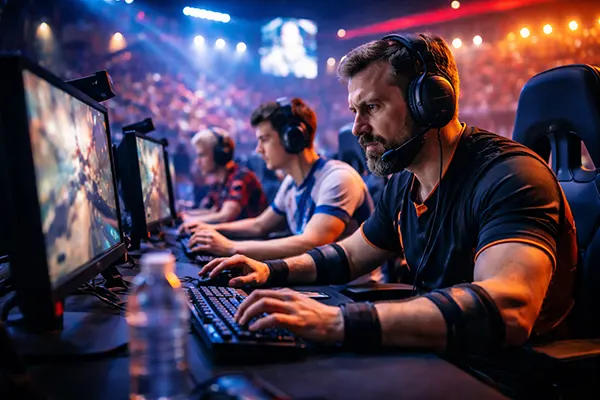
Physical strain is more real than fans often assume. Modern esports is a repetitive, high-intensity job: wrist extension, finger flexion, shoulder tension, and long hours seated in fixed posture. Recent sports medicine research reports a high prevalence of pain among esports players, with the spine and upper extremities frequently affected. Even when pain isn’t career-ending, it can cut practice quality, reduce confidence in high-speed mechanics, and turn every tournament into a recovery puzzle.
Burnout is the second quiet driver. Competitive pressure is constant, and unlike many traditional sports, the public “performance review” happens daily on livestreams, social media, and ranked ladders. A slump is not private; it’s content. Over time, that environment can make even successful careers feel psychologically expensive. Some players don’t retire because they are washed. They retire because they are tired of being “on” all the time.
Finally, esports has a timing problem. A player’s prime years often overlap with major life decisions: education, relationships, financial stability, and long-term planning. If contracts are short, prize money is volatile, and there is no strong player union or safety net in a given scene, stepping away can be the rational choice. In other words, “retirement” often looks less like losing skill and more like choosing a safer life path.
What ageing really changes: roles, games, and skills that grow with time
Age affects esports unevenly. In games that demand extremely high actions per minute and constant micro-adjustments, small declines in speed can be costly. In games where information management, rotations, macro calls, and teamfight planning matter more, experience can compensate for pure mechanics. This is why you’ll see different age curves across scenes, and why some players shift roles rather than disappear.
Many veterans extend their careers by moving into decision-heavy positions: in-game leader, captain, shot-caller, support, or specialist roles that reward anticipation and composure. Those roles are not “easier”; they are different. They require communication discipline, pattern recognition, and emotional control when a match tilts. These are skills that often improve with age, because they are built from repetition and hard lessons, not youthful speed.
It also helps that esports training has slowly become more professional. In 2026, more top teams invest in coaching, analysts, sports psychology, physio support, and better scheduling. That doesn’t erase the age factor, but it changes the cost of staying competitive. When a player has access to recovery routines, ergonomic set-ups, and sensible practice design, the “drop-off” becomes less brutal and more manageable.
How veterans adapt to stay relevant
Adaptation usually starts with efficiency. Older pros who keep winning tend to play “cleaner”: fewer unnecessary fights, less panic movement, more deliberate crosshair placement, and better timing. They rely on prediction rather than reaction, forcing opponents into situations where speed matters less than positioning. This is why you’ll often hear pros say that the game “slows down” for experienced players, even if their hands aren’t as fast as they were at 18.
Another common adaptation is narrowing the skill focus. Instead of trying to out-mechanic everyone in every situation, veterans often specialise: map control, utility usage, vision management, clutch decision-making, or tempo-setting calls. These micro-edges don’t look flashy on highlight reels, but they win series. And because they are knowledge-based, they can remain stable over longer periods.
Finally, veterans who last tend to treat their body like part of their kit. That means structured warm-ups, breaks, forearm strength work, wrist-load management, and posture discipline. It also means being honest about fatigue and reducing low-quality practice hours. The irony is that younger players often grind more, but older players often practise better.
Who breaks the trend in 2026, and what their careers have in common
The clearest counterargument to the “esports ends at 25” narrative is simple: look at the people still winning, leading, or competing deep into their late 20s, 30s, and beyond. League of Legends is the obvious example because the scene is mature and well-resourced. Lee “Faker” Sang-hyeok re-signed with T1 through 2029, which signals both personal longevity and an organisational willingness to build around a veteran rather than constantly reset.
Counter-Strike has long shown that leadership ages well. Finn “karrigan” Andersen, born in 1990, remains an active top-level in-game leader in CS2. His value is not just aim; it’s mid-round calls, team structure, and the ability to keep a roster stable under pressure. In scenes like CS, where tactics and coordination decide championships, that kind of leadership can be worth more than raw mechanical peak.
And then there’s the fighting game community, where the longevity curve looks completely different. Daigo Umehara (born 1981) is still competing professionally, and in recent years he has publicly emphasised focusing on serious competition rather than spreading energy across constant streaming. Fighting games reward reactions too, but they also reward reads, matchup knowledge, and calm decision-making — ingredients that tend to age surprisingly well.
What “career longevity” actually looks like now
First, long careers are rarely accidental. The players who last usually have a support system: coaching that challenges bad habits, physical routines that prevent repetitive strain from becoming chronic, and lifestyle structure that reduces burnout. When those pieces are missing, even a gifted player can burn out quickly. When they exist, the same player can stay dangerous for years longer than fans expect.
Second, veterans often redefine success. Not everyone who stays in esports aims to be the mechanical superstar forever. Some become leaders, specialists, mentors, or role anchors who make younger teammates better. That’s not a downgrade. It is a shift in how value is created inside a team. In 2026, more organisations understand that stability, culture, and decision-making can be competitive advantages.
Third, the scenes most likely to produce long careers are the ones with better infrastructure: clearer competitive calendars, stronger coaching ecosystems, decent minimum salaries, and real health support. As esports continues to mature, the “retire at 24” story becomes less of a rule and more of a reflection of older, rougher systems. The trend isn’t fully broken, but it is being bent—mostly by players who treat longevity as a skill, not a coincidence.